The Intersection of Roulette and Modern Probability Theory for Strategic Players

Let’s be honest: roulette is the glittering, spinning heart of the casino. It’s pure theater. The clatter of the ball, the hypnotic wheel, that breathless moment before it settles. And for centuries, players have tried to outsmart it. They’ve devised complex betting systems, tracked numbers, looked for biases—all in pursuit of an edge.
But here’s the deal. To truly understand the game, you need to look past the velvet rope and into the cold, beautiful logic of modern probability theory. It’s where hope meets math. And for the strategic player, that intersection isn’t about finding a magic bullet. It’s about managing reality.
The Unshakeable Foundation: The House Edge Isn’t a Suggestion
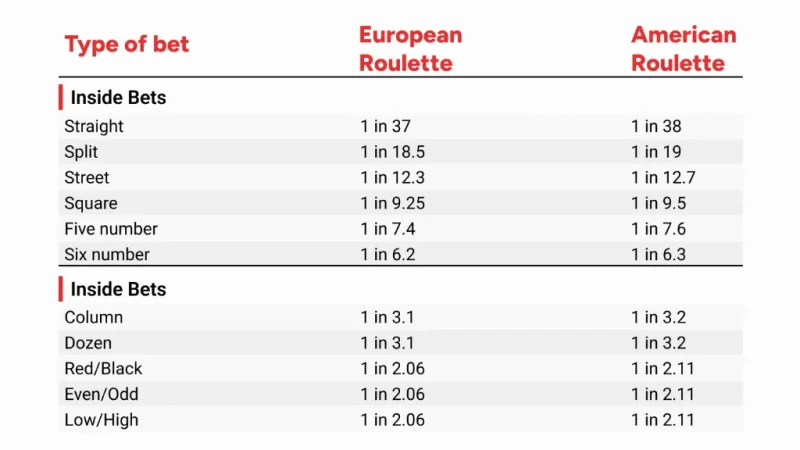
First thing’s first. Probability theory gives us the house edge—not as a vague concept, but as a precise, immutable law. On a single-zero European wheel, the probability of your straight-up bet hitting is 1 in 37 (or 1/37). The payout, though, is 35 to 1.
Do the math: (1/37 * 35) + (36/37 * -1) = -0.027. That’s a 2.7% expected loss, right there. It’s the tax on the thrill. American wheels with their double zero? That edge jumps to 5.26%. This isn’t a flaw; it’s the feature. Modern game theory frames this as a negative expectation game. Every spin is statistically independent. The wheel has no memory.
And yet, knowing this cold hard fact is the first, most strategic move you can make. It shifts your goal from “winning in the long run” to something more nuanced: optimizing experience within mathematical boundaries.
Betting Systems Under the Microscope: The Law of Large Numbers Bites
Everyone’s heard of the Martingale. Double your bet after a loss, recover all losses with one win. It feels powerful, like a sure thing. Probability theory, specifically the concept of independent trials and expected value, shows us the cracks.
| System | The Promise | Probability Theory’s Reality Check |
| Martingale | Recover losses with one win. | Finite bankrolls hit table limits fast. A short losing streak causes catastrophic loss. |
| Fibonacci | More gradual progression, less risky. | Still relies on infinite funds. Wins remain small; one long loss sequence wipes out profits. |
| D’Alembert | Increase/decrease bets by one unit. | Milds the volatility but doesn’t change the negative expectation. You’re just pacing the inevitable. |
These systems are about variance management, not expectation change. They rearrange how you might win or lose in the short term—the distribution of outcomes—but they can’t touch that house edge. It’s like rearranging deck chairs, you know? A beautiful, compelling, but ultimately futile exercise against the law of large numbers.
Where Theory Meets the Real Wheel: The Bias Hunt
Now, this is where it gets interesting. Modern statistical analysis—think data science—did provide a historical, if fleeting, edge. In the pre-digital age, wheels weren’t perfect. Imperfections could cause mechanical bias, making some numbers or sections “hot.”
Strategic players like Joseph Jagger (the “Man Who Broke the Bank at Monte Carlo”) exploited this in the 1800s. Today, this means understanding that probability models assume perfect randomness. A real, physical wheel is a machine. In theory, with enough observation (thousands of spins), you could detect a statistical deviation. But here’s the catch: modern casinos use high-precision wheels and regularly maintain them. The window for this edge is practically, well, closed. Still, the concept teaches a vital lesson: always know the difference between a theoretical model and the physical game in front of you.
A Strategic Player’s Toolkit: Concepts That Actually Matter
So, if you can’t beat the edge, what does a probability-informed strategy look like? It’s a shift in mindset, built on a few key pillars:
- Expected Value (EV) as Your North Star: Every bet has a negative EV. Accept it. Your strategy then becomes about choosing the bets with the least negative EV. European roulette (single zero) is objectively better than American. Even-money bets (like red/black) have a lower probability of winning on a single spin than you might think—48.6% vs. 50%—but they lose less over time compared to a long-shot straight-up number.
- Bankroll Management as Survival: This is where probability gets practical. Use concepts like risk of ruin. Decide on a loss limit before you play—a percentage of your total fun budget. This isn’t about beating the odds; it’s about ensuring the odds don’t wipe you out in one session. It’s the difference between a night out and a financial disaster.
- Variance is the Story, Not the Ending: Short-term results are wild. Probability theory calls this variance. You might win 10 even-money bets in a row. You might lose 15. The strategic player doesn’t see a winning streak as a system working, or a losing streak as the wheel being “cold.” They see it as natural fluctuation around a predictable mean. Don’t chase variance; just understand it’s the price of admission.
The Digital Frontier: RNGs and the Illusion of Control
Online roulette uses Random Number Generators (RNGs). These are algorithms designed to be perfectly, cryptographically random. The physical biases are gone. This is probability theory in its purest, most unforgiving form. Every spin is more independent than ever. For the strategic player, this simplifies things: focus entirely on EV and bankroll. The “feel” of the game is irrelevant. It’s just math now.
And that, honestly, can be liberating.
The Final Spin: Strategy as Informed Engagement
So, what’s the takeaway from this intersection of ivory ball and abstract theory? True strategy isn’t a betting grid. It’s an intellectual framework.
You walk up to the table knowing the immutable facts. You choose the best odds available (single-zero wheel, always). You set a hard limit based on your funds, not a feeling. You view the beautiful chaos of the wheel for what it is—a spectacle of variance dancing around a fixed point. You enjoy the ride, the social buzz, the tension, precisely because you understand the mechanics of the ride itself.
In the end, modern probability theory doesn’t give you a way to win. It gives you the clarity to play—and to stop—on your own terms. That might just be the smartest bet of all.