Roulette Odds and Payouts Explained for Beginner Bettors
Picture this: you’re standing at a roulette table for the first time. The wheel spins, the ball bounces, and everyone around you seems to know exactly what’s happening. Meanwhile, you’re just hoping your chip lands somewhere decent. Sound familiar?
Here’s the deal — roulette looks complicated, but it’s really not. Once you understand the odds and payouts, you’ll feel like you’ve been playing for years. Let’s break it down.
The Two Main Types of Roulette (And Why It Matters)
Before we talk numbers, you need to know which wheel you’re playing on. There are two main versions:
- European Roulette — has 37 pockets (numbers 1-36 plus a single zero)
- American Roulette — has 38 pockets (numbers 1-36 plus zero and double zero)
That extra pocket on the American wheel might not seem like a big deal. But honestly? It changes everything. The house edge jumps from 2.7% on European wheels to 5.26% on American ones. That’s nearly double the disadvantage.
If you have a choice, always pick European. Your bankroll will thank you later.
Understanding Roulette Odds: The Basics
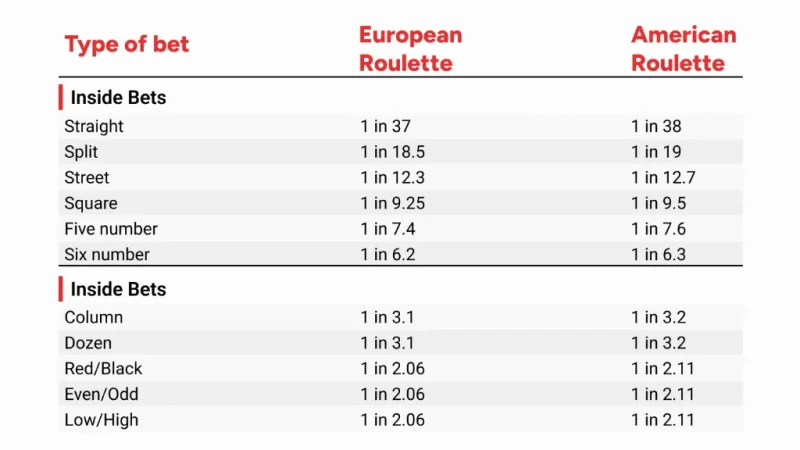
Odds in roulette are simply the probability of a specific outcome happening. On a European wheel with 37 numbers, your chance of hitting any single number is 1 in 37. On an American wheel, it drops to 1 in 38.
But here’s where it gets interesting — the payouts don’t always match the true odds. That gap is how the casino makes its money. It’s not a scam, it’s just math. And once you see it clearly, you can make smarter bets.
Inside Bets vs. Outside Bets
Roulette bets fall into two categories: inside and outside. Think of inside bets as sniper shots — precise, risky, but potentially rewarding. Outside bets are more like casting a wide net — better odds, smaller payouts.
Inside Bets
These are bets placed on specific numbers or small groups of numbers. They have lower odds of hitting but pay more when they do.
| Bet Type | Numbers Covered | Payout | Odds (European) |
|---|---|---|---|
| Straight Up | 1 | 35:1 | 2.7% |
| Split | 2 | 17:1 | 5.4% |
| Street | 3 | 11:1 | 8.1% |
| Corner | 4 | 8:1 | 10.8% |
| Six Line | 6 | 5:1 | 16.2% |
See the pattern? The more numbers you cover, the lower the payout — but the higher your chance of winning something.
Outside Bets
These cover larger sections of the wheel. They’re easier to hit, which is why beginners tend to gravitate toward them.
| Bet Type | Numbers Covered | Payout | Odds (European) |
|---|---|---|---|
| Red/Black | 18 | 1:1 | 48.6% |
| Odd/Even | 18 | 1:1 | 48.6% |
| High/Low | 18 | 1:1 | 48.6% |
| Dozen | 12 | 2:1 | 32.4% |
| Column | 12 | 2:1 | 32.4% |
Notice something? Those 1:1 bets look tempting because they hit almost half the time. And sure, they do. But the payout is small, and the zero still gives the house its edge.
How Payouts Actually Work
When you see “35:1” on a straight-up bet, it means you get 35 chips for every 1 chip you wager — plus your original bet back. So a $10 bet on a single number wins you $350 in profit, and you keep your $10 too.
It’s important to understand that payouts are based on the odds of hitting that bet, not the true probability. That difference — the house edge — is baked into every single bet on the table. Every. Single. One.
Well, almost every one. Some casinos offer “en prison” or “la partage” rules on even-money bets that reduce the house edge further. But that’s a topic for another day.
The House Edge: Your Silent Opponent
Let’s talk about the elephant in the room. The house edge isn’t a fee you pay upfront — it’s a mathematical advantage that plays out over thousands of spins. On a European wheel, the house edge is 2.7%. On an American wheel, it’s 5.26%.
What does that mean in practice? For every $100 you wager over time, you can expect to lose about $2.70 on a European wheel. It doesn’t happen in a straight line, of course. Some sessions you’ll win big. Others… not so much.
But here’s the thing — no betting system can overcome the house edge. Not Martingale, not Fibonacci, not any of those fancy patterns you see on YouTube. They change how you bet, not the underlying math.
Which Bets Are Best for Beginners?
If you’re just starting out, here’s a simple approach:
- Stick to European roulette whenever possible
- Start with outside bets — red/black, odd/even, high/low
- Set a budget before you sit down and stick to it
- Avoid the five-number bet on American wheels (it has the worst odds on the table)
Outside bets won’t make you rich overnight. But they’ll keep you in the game longer, which means more entertainment for your money. And honestly? That’s what casual gambling is about.
A Quick Word on Online Roulette
Online roulette has exploded in popularity, and for good reason. You can play from your couch, compare odds across different casinos, and often find better rules than at physical tables. Many online casinos now offer European wheels with la partage, which cuts the house edge to just 1.35% on even-money bets.
That said, not all platforms are created equal. Check the rules before you play. Some sites sneak in American wheels by default, and that extra zero really does make a difference.
Final Thoughts
Roulette is a game of chance — no amount of strategy changes that. But understanding the odds and payouts gives you something just as valuable: clarity. You’ll know exactly what you’re risking, what you stand to gain, and why the casino always has that slight edge.
And that knowledge? It turns a confusing spinning wheel into something you can actually enjoy. So go ahead, place your bet. Just make sure it’s one you understand.